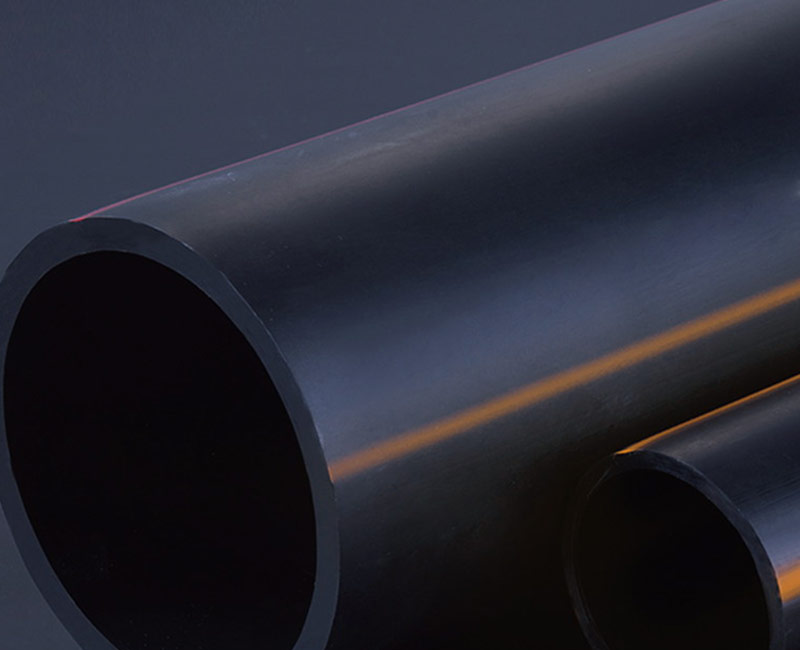
With stable product quality and advanced manufacturing processes, we provide safe, durable and efficient pipeline solutions for various infrastructure construction projects.
HDPE Gas Pipe is widely used in gas transmission systems due to its superior safety, durability, and long service performance. It effectively eliminates corrosion and joint leakage problems commonly found in steel and cast iron pipelines, ensuring stable and secure operation of gas networks.
The HDPE material is chemically inert and resistant to a wide range of chemical media, making it suitable for complex underground environments. It also has a low coefficient of friction, resulting in low flow resistance and higher transport efficiency.
HDPE Gas Pipe uses electrofusion welding technology, forming joints with strength higher than the pipe body itself, which significantly improves system reliability and sealing performance. The material typically has an elongation at break exceeding 500%, providing excellent toughness and deformation resistance.
In addition, HDPE Gas Pipe demonstrates strong seismic resistance, flexibility, and excellent resistance to scratch damage. It also performs well against slow crack growth (SCG) and rapid crack propagation (RCP), ensuring long-term operational safety in gas pipeline applications.
The HDPE Gas Pipe is a high-performance polyethylene piping solution designed for safe and efficient gas transmission systems. It is widely used in underground urban gas networks due to its stable mechanical properties, corrosion resistance, and reliable long-term performance under varying environmental conditions.
As a key material in modern pipeline engineering, HDPE Gas Pipe supports multiple gas transport applications, including natural gas, manufactured gas, liquefied petroleum gas, and biogas.
HDPE material features an extremely low embrittlement temperature, enabling stable performance within a temperature range of -60°C to 60°C. This ensures safe construction and operation in cold environments, where traditional materials may become brittle and crack. The HDPE Gas Pipe maintains structural integrity even under sudden impact during winter installation or operation.
HDPE Gas Pipe demonstrates low notch sensitivity and high shear strength, which significantly reduces the risk of crack initiation and propagation. Its excellent scratch resistance and environmental stress cracking resistance make it suitable for demanding underground installation conditions where external stress factors are present.
The pipe contains 2–2.5% uniformly distributed carbon black, which enhances resistance to ultraviolet radiation. As a result, HDPE Gas Pipe can be safely stored or used outdoors for up to 50 years without performance degradation caused by aging or environmental exposure.
HDPE material is highly resistant to chemical corrosion from substances commonly found in soil. It does not react with acids, alkalis, or salts, ensuring long-term stability. In addition, as an electrical insulator, HDPE Gas Pipe avoids rusting, rotting, or electrochemical corrosion, making it highly suitable for buried pipeline systems.
HDPE Gas Pipe systems are typically connected using electrofusion technology. This method creates joints whose strength can exceed that of the pipe body itself, ensuring a sealed, stable, and leak-free pipeline network suitable for gas transmission safety requirements.
| Nominal Outer Diameter(mm) | Minimum Wall Thickness(mm) | |||
| SDR11 | SDR17 | SDR21 | SDR26 | |
| 16 | 3.0 | |||
| 20 | 3.0 | 1 | – | – |
| 25 | 3.0 | – | – | |
| 32 | 3.0 | 3.0 | – | |
| 40 | 3.7 | 3.0 | – | – |
| 50 | 4.6 | 3.0 | 3.0 | |
| 63 | 5.8 | 3.3 | 3.0 | – |
| 75 | 6.8 | 4.5 | 3.6 | 3.0 |
| 90 | 8.2 | 5.4 | 4.3 | 3.5 |
| 110 | 10.0 | 6.6 | 5.3 | 4.2 |
| 125 | 11.4 | 7.4 | 6.0 | 4.8 |
| 140 | 12.7 | 8.3 | 6.7 | 5.4 |
| 160 | 14.6 | 9.5 | 7.7 | 6.2 |
| 180 | 16.4 | 10.7 | 8.6 | 6.9 |
| 200 | 18.2 | 11.9 | 9.6 | 7.7 |
| 225 | 20.5 | 13.4 | 10.8 | 8.6 |
| 250 | 22.7 | 14.8 | 11.9 | 9.6 |
| 280 | 25.4 | 16.6 | 13.4 | 10.7 |
| 315 | 28.6 | 18.7 | 15.0 | 12.1 |
| 355 | 32.2 | 21.1 | 16.9 | 13.6 |
| 400 | 36.4 | 23.7 | 19.1 | 15.3 |
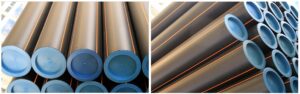
Electrofusion connection uses specialized fittings with embedded resistance wires. When electric current passes through, heat is generated to melt both the fitting inner surface and the pipe outer surface. After cooling, a strong and integrated joint is formed, ensuring reliable sealing performance for HDPE Gas Pipe systems.
This method heats both the pipe spigot end and the fitting socket simultaneously. Once the surfaces reach a molten state, the pipe is inserted into the fitting and held in place until cooling completes. The result is a stable and durable connection suitable for gas pipeline installation.
Thermofusion butt connection involves heating the ends of HDPE pipes using a heating plate until they reach a molten state. The ends are then pressed together under controlled pressure and allowed to cool naturally. This traditional method is widely used in polyethylene pipeline systems, including HDPE Gas Pipe installations, ensuring strong and continuous pipeline integrity.
HDPE Gas Pipe is suitable for buried polyethylene gas transmission systems operating in underground urban environments. It is designed for use under temperatures ranging from -20°C to 40°C, with a maximum permissible working pressure not exceeding 0.7 MPa.
It can be used for transporting multiple types of gases, including:
These characteristics make HDPE Gas Pipe a practical solution for modern urban energy infrastructure and underground gas distribution systems.
If you are interested in collaboration, require project consultation, or wish to discuss business opportunities, please feel free to contact us. We look forward to establishing a long-term cooperative relationship with you.