- weitigong.......
- weitigong.......
With stable product quality and advanced manufacturing processes, we provide safe, durable and efficient pipeline solutions for various infrastructure construction projects.
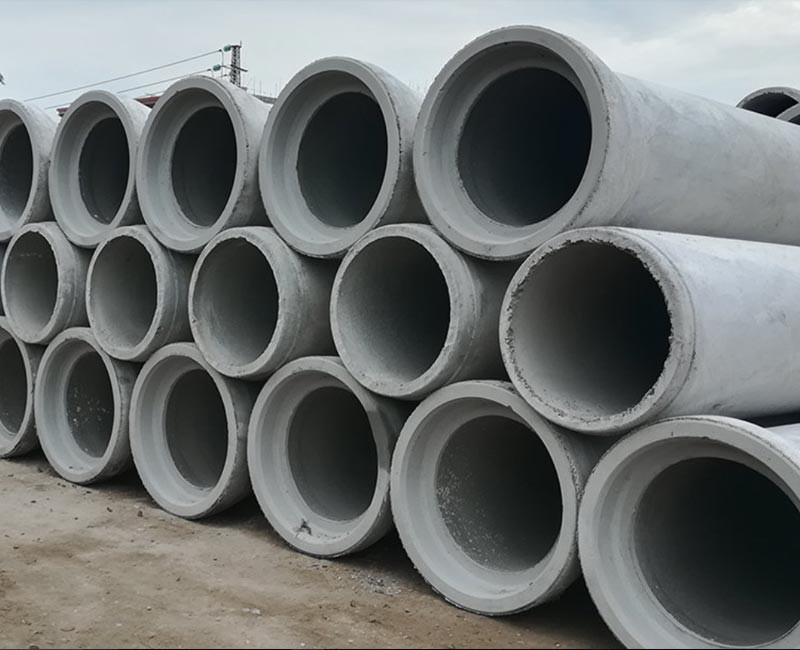
Concrete pipes are classified into four categories: plain concrete pipes, ordinary reinforced concrete pipes, self-stressed reinforced concrete pipes, and prestressed concrete pipes. Based on their inner diameter, they can be divided into small-diameter pipes (below 400 mm), medium-diameter pipes (400–1400 mm), and large-diameter pipes (above 1400 mm). According to their water pressure resistance, they can be divided into low-pressure pipes and pressure pipes; pressure pipes typically have working pressures of 0.4, 0.6, 0.8, 1.0, and 1.2 MPa. Compared to steel pipes, concrete pipes can be further classified by joint type: plain-end pipes, socket-type pipes, and tongue-and-groove pipes. Joint types include cement mortar joints, wire mesh cement mortar joints, cement mortar socket joints, and rubber ring socket joints.
The Concrete Pipe is manufactured using high-quality washed medium sand as aggregate and stable silicate 42.5 cement as the primary binding material. This combination ensures consistent material quality and stable long-term performance in underground infrastructure applications.
The Concrete Pipe is produced with carefully selected materials that ensure structural reliability and durability. The use of washed medium sand and high-grade cement provides stable mechanical properties and long-term operational consistency in drainage and utility systems.
During the manufacturing process of Concrete Pipe, a strictly controlled high-strength mix ratio is applied. Density is precisely regulated at each production stage to maintain uniform structure and reduce the risk of leakage, ensuring reliable performance in engineering applications.
The reinforcement design of Concrete Pipe strictly follows national standard structural drawings without any reduction in steel reinforcement. This ensures full compliance with regulatory requirements and provides strong resistance to external loads and soil pressure in underground installations.
The Concrete Pipe is supported by a complete after-sales service system that monitors project progress in real time. Coordination with construction teams helps improve installation efficiency, reduce project delays, and ensure smooth execution throughout the pipeline engineering process.
| Nominal Inner Diameter(mm) | Design Effective Length(mm) | Class 1 Pipe | Class 2 Pipe | ||||
| Design Wall Thickness(mm) | Destructive Load(Kn/m) | Internal Water Pressure(MPa) | Design Wall Thickness(mm) | Destructive Load(Kn/m) | Internal Water Pressure(MPa) | ||
| 200 | ≥1000 | ≥22 | 8 | 0.02 | ≥27 | 12 | 0.04 |
| 250 | ≥25 | 9 | ≥33 | 15 | |||
| 300 | ≥30 | 10 | ≥40 | 18 | |||
| 350 | ≥35 | 12 | ≥45 | 19 | |||
| 400 | ≥40 | 14 | ≥47 | 19 | |||
| 450 | ≥45 | 16 | ≥50 | 19 | |||
| 500 | ≥50 | 17 | ≥55 | 21 | |||
| 600 | ≥60 | 21 | ≥65 | 24 | |||
Buried polyethylene (PE) pipelines for natural gas are suitable for underground urban gas transmission systems operating at temperatures between -20°C and 40°C, with a maximum permissible working pressure not exceeding 0.7 MPa. Suitable gas types for transmission include:
1. Natural gas: such as pure natural gas, associated petroleum gas, mine gas, etc.
2. Manufactured gas: such as coke oven gas, water gas, oil-based gas, blast furnace gas, etc.
3. Liquefied petroleum gas (LPG);
4. Biogas.
If you are interested in collaboration, require project consultation, or wish to discuss business opportunities, please feel free to contact us. We look forward to establishing a long-term cooperative relationship with you.