Table of Contents
Introduction
PE-RT pipe has become an important piping solution for underfloor heating, radiant heating, and selected hot-water applications because it combines elevated-temperature performance with flexibility and practical installation characteristics.
For an underfloor heating project, however, simply specifying “PE-RT pipe” is not enough. Engineers, contractors, distributors, and project buyers also need to consider pipe type, dimensions, operating temperature, system pressure, oxygen-barrier requirements, circuit length, bending flexibility, connection methods, and applicable standards.
These details directly affect installation efficiency and long-term system reliability.
This guide explains how PE-RT pipe works, where it is commonly used, how Type I and Type II differ, why oxygen barriers matter, and what buyers should confirm before selecting pipe for a heating project.
For residential projects involving water supply and radiant heating, Bihe’s residential plumbing solutions include PE-RT piping designed for underfloor heating and related building applications.
What Is PE-RT Pipe?
PE-RT stands for Polyethylene of Raised Temperature Resistance.
It is a polyethylene material developed to maintain useful long-term mechanical properties at elevated temperatures while retaining the flexibility associated with polyethylene piping.
Unlike cross-linked polyethylene systems, PE-RT achieves its temperature resistance through its molecular structure rather than relying on a post-extrusion cross-linking process.
This gives PE-RT several characteristics that make it attractive for heating systems:
- good flexibility;
- resistance to corrosion;
- smooth internal surfaces;
- suitability for elevated-temperature water;
- easy routing through long heating circuits;
- relatively low weight;
- compatibility with multilayer and oxygen-barrier structures.
The international ISO 22391 standard covers PE-RT piping systems intended for hot and cold water installations and heating systems under defined temperature and pressure conditions.
Why PE-RT Pipe Is Used for Underfloor Heating
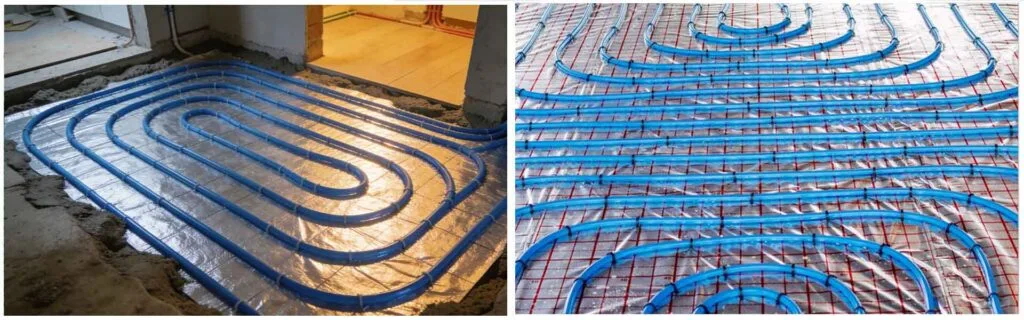
Hydronic underfloor heating works by circulating heated water through pipe circuits installed beneath the finished floor.
Instead of concentrating heat at a radiator, the system distributes thermal energy across a much larger floor surface.
That makes the pipe itself a critical component.
The pipe must tolerate repeated temperature cycles while remaining flexible enough to form long loops across the floor.
PE-RT performs well in this environment because it can be bent around circuit layouts without requiring a fitting at every change in direction.
Reducing unnecessary concealed joints is particularly important beneath floors, where future access may be difficult.
Bihe uses PE-RT in its multi-scenario piping solutions, including underfloor heating, hot-water systems, and radiant heating circuits.
PE-RT Pipe Structure Explained
Not all PE-RT heating pipes have the same construction.
A project may use a basic single-layer pipe or a multilayer product designed to provide additional properties.
| PE-RT Pipe Structure | Main Characteristic | Typical Consideration |
|---|---|---|
| Single-layer PE-RT | Simple flexible structure | Basic heating applications |
| PE-RT with oxygen barrier | Reduces oxygen diffusion | Closed-loop heating systems |
| Multilayer PE-RT | Combines functional layers | Higher system requirements |
| Anti-scaling structure | Designed to maintain cleaner internal surface | Long-term heating efficiency |
| Composite barrier structure | Adds protection or stability | Project-specific applications |
The correct structure depends on the heating system rather than on the pipe appearance alone.
For example, a pipe used in a closed-loop heating system containing metal pumps, boilers, valves, or manifolds may require different oxygen-diffusion considerations from a simple water distribution line.
PE-RT Type I vs Type II
One important distinction buyers may encounter is PE-RT Type I and PE-RT Type II.
Both belong to the PE-RT material family, but they are not identical grades.
ISO 22391 recognizes both Type I and Type II materials for PE-RT piping systems.
In practical specification work, the difference should not be reduced to a simple statement that one type is always “good” and the other is always “better.”
Their suitability depends on:
- operating temperature;
- pressure requirement;
- pipe dimensions;
- design life;
- application class;
- material performance;
- manufacturer specification.
Type II materials are generally associated with enhanced long-term performance under demanding temperature and pressure conditions, but engineers should always evaluate the certified pipe system rather than selecting material only from the type name.
For procurement purposes, buyers should ask the manufacturer to clearly identify the resin grade, pipe standard, dimensions, and test data associated with the proposed product.
Temperature Performance of PE-RT Pipe
One of the main reasons PE-RT is selected for heating applications is its ability to operate at elevated water temperatures.
However, buyers should avoid treating a single “maximum temperature” figure as the complete specification.
There are several different temperature conditions in a heating system:
Normal operating temperature refers to the temperature the system experiences during regular operation.
Peak operating temperature may occur temporarily under specific system conditions.
Exceptional temperature describes unusual or short-duration conditions that should not be confused with normal continuous operation.
The pipe’s long-term performance depends on the combination of temperature, pressure, duration, pipe dimensions, and application class.
This is why the ISO 22391 framework evaluates PE-RT piping according to defined service conditions rather than relying on one universal maximum-temperature claim.
Temperature and Pressure Must Be Evaluated Together
Heating pipe selection should never consider temperature independently of pressure.
A PE-RT pipe exposed to high temperature and low pressure is operating under different mechanical conditions from the same pipe exposed to high temperature and higher pressure.
The design should therefore consider:
| Parameter | Why It Matters |
|---|---|
| Normal water temperature | Determines long-term thermal exposure |
| Maximum design temperature | Helps evaluate peak conditions |
| Working pressure | Creates continuous internal stress |
| Pipe wall thickness | Influences pressure capability |
| Pipe diameter | Influences hydraulics and wall geometry |
| Heating duration | Affects long-term exposure |
| Application class | Defines expected service conditions |
Project buyers should request technical data for the exact pipe specification rather than applying the same temperature and pressure values to every PE-RT product.
What Is an Oxygen Barrier PE-RT Pipe?
Oxygen barrier is one of the most important concepts in modern hydronic heating systems.
Plastic materials can allow small amounts of oxygen to diffuse through the pipe wall over time.
In a closed heating circuit containing metallic components, excessive oxygen entering the circulating water can contribute to corrosion.
Potentially affected components may include:
- pumps;
- boilers;
- manifolds;
- valves;
- steel fittings;
- heat exchangers;
- other metallic equipment.
An oxygen-barrier PE-RT pipe adds a layer designed to reduce oxygen diffusion through the pipe wall.
EVOH, or ethylene vinyl alcohol, is commonly used as the barrier material in multilayer heating pipes.
This does not make the pipe itself “stronger” in every respect. Instead, the barrier performs a specific system-level function: helping reduce oxygen entry into the heating circuit.
When Is an Oxygen Barrier Important?
An oxygen barrier becomes especially relevant when the heating system contains metal components vulnerable to corrosion.
Consider two hypothetical systems.
The first is a closed-loop underfloor heating system connected to a boiler, manifold, circulation pump, and multiple metallic components.
The second has a different system configuration with materials and equipment selected specifically around oxygen management.
The requirements may differ.
The correct question is therefore not simply:
“Is oxygen barrier pipe better?”
A better question is:
“Does this heating system require controlled oxygen permeability to protect the complete hydronic circuit?”
For projects where oxygen diffusion is a concern, barrier-layer PE-RT can provide an important additional system feature.
PE-RT Pipe vs Standard Polyethylene Pipe
Standard polyethylene materials are widely used for water, gas, irrigation, and infrastructure applications, but not every polyethylene grade is designed for prolonged elevated-temperature service.
PE-RT is specifically engineered around increased temperature resistance.
That distinction is important in heating systems.
| Factor | PE-RT Pipe | Conventional PE Pipe |
|---|---|---|
| Flexibility | High | High |
| Elevated-temperature application | Designed for it | Grade-dependent |
| Underfloor heating | Common | Not typical for standard grades |
| Radiant heating | Common | Application-dependent |
| Cold-water infrastructure | Possible depending on system | Very common |
| Heating-specific standards | Available | Different standards apply |
The material designation therefore matters.
A pipe should not be assumed suitable for radiant heating simply because it is made from polyethylene.
PE-RT Pipe vs PEX
PE-RT and PEX are both commonly associated with heating and hot-water applications, but their material structures are different.
PEX is cross-linked polyethylene. The manufacturing process creates cross-links between polymer chains to improve temperature and mechanical performance.
PE-RT achieves elevated-temperature resistance without the same cross-linking process.
For heating-system buyers, the most useful comparison is not simply which material is “better.”
Instead, compare:
- required temperature range;
- operating pressure;
- pipe flexibility;
- oxygen barrier construction;
- fitting system;
- installation method;
- dimensional standard;
- certifications;
- project specifications;
- local market requirements.
Both material families can be appropriate when the system is properly designed.
A dedicated material comparison will be covered later in the Bihe blog plan so that this PE-RT guide can remain focused on PE-RT specification and selection.
Why Flexibility Matters in Floor Heating
Underfloor heating circuits often contain long continuous pipe runs.
The installer needs to route the pipe repeatedly across the floor in patterns such as serpentine or spiral layouts.
Good flexibility helps the pipe follow these circuits while reducing the number of fittings hidden beneath the finished floor.
This can provide several practical advantages.
Installation can become faster, layout changes are easier to accommodate, and continuous loops can reduce the number of concealed connection points.
However, flexibility does not mean that the pipe can be bent without limits.
Every product has a recommended minimum bending radius. Excessive bending can cause deformation, kinking, or damage to multilayer construction.
Installers should therefore follow the manufacturer’s bending recommendations.
Choosing PE-RT Pipe Diameter
Pipe diameter influences flow resistance, circuit length, heat output, pumping requirements, and installation layout.
For underfloor heating, diameter should be considered together with:
- required heating load;
- room size;
- circuit length;
- water flow rate;
- temperature difference;
- manifold design;
- pump capability;
- pipe spacing.
A larger pipe does not automatically produce a better heating system.
Likewise, choosing the smallest possible pipe merely to simplify installation can increase pressure loss.
The heating designer should balance hydraulic resistance and heat-transfer requirements.
Pipe Spacing and Heating Performance
Pipe spacing is the center-to-center distance between adjacent pipe runs beneath the floor.
Closer spacing can generally provide more uniform heat distribution and greater heat-transfer potential, while wider spacing reduces pipe usage but may produce greater differences in floor-surface temperature.
Suitable spacing depends on factors including:
- required room heat load;
- floor construction;
- insulation;
- floor covering;
- supply-water temperature;
- exterior wall exposure;
- window area;
- climate conditions.
Areas near large windows or external walls may require different design consideration from interior zones.
This means pipe spacing should be calculated as part of the heating design rather than copied from another building.
Floor Construction Also Affects Pipe Selection
PE-RT pipe does not operate independently of the floor assembly.
Heat must travel from the water through the pipe wall and surrounding floor structure before reaching the occupied space.
Common floor components may include:
- structural slab;
- insulation layer;
- pipe fixing system;
- PE-RT heating pipe;
- screed or thermal distribution layer;
- finished floor covering.
Poor insulation beneath the heating pipe can allow useful energy to move downward rather than toward the occupied room.
Floor coverings also influence thermal resistance.
Tile, engineered flooring, laminate, carpet, and other materials may have different heating-system requirements.
The pipeline should therefore be selected as one component of the full radiant-floor design.
PE-RT Pipe for Residential Heating
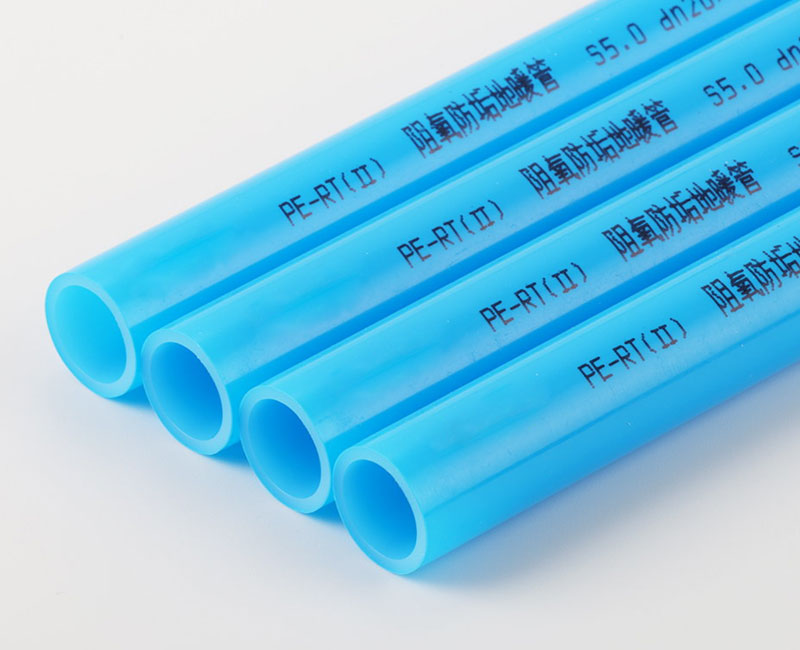
Residential buildings are one of the most common application environments for PE-RT floor heating.
A typical system may use:
- a heat source;
- circulation pump;
- manifold;
- supply and return lines;
- multiple PE-RT floor loops;
- thermostatic controls.
Each room or zone may contain one or more circuits according to the heating load and floor area.
Bihe’s residential piping solutions integrate PE-RT with other piping materials used for domestic water, drainage, and heating, allowing the heating network to be considered as part of the building’s wider piping infrastructure.
PE-RT Pipe in Commercial Buildings
Underfloor and radiant heating are not limited to private houses.
Potential applications can include:
- offices;
- hotels;
- schools;
- healthcare buildings;
- retail spaces;
- apartments;
- public buildings.
Commercial projects may place greater emphasis on system zoning, installation consistency, project quantities, manifolds, documentation, and construction scheduling.
For large installations, a small difference in pipe specification or installation method can have a significant impact when multiplied across thousands of meters of heating circuits.
B2B buyers should therefore confirm technical specifications before bulk procurement rather than relying only on sample appearance.
How to Select PE-RT Pipe for Underfloor Heating
A practical selection process starts with the project rather than the product catalogue.
Define the Heating Application
Determine whether the pipe will be used for underfloor heating, wall heating, radiant heating, hot-water transport, or another approved application.
Confirm Temperature and Pressure
Identify normal operating conditions and possible peak conditions.
Do not specify the pipe solely according to a short-term maximum temperature.
Determine Pipe Diameter
Use hydraulic design and circuit layout to determine a suitable diameter.
Confirm Pipe Structure
Decide whether the project requires a single-layer, multilayer, oxygen-barrier, or other PE-RT structure.
Check the Material Grade
Confirm whether Type I or Type II is specified and obtain appropriate technical documentation.
Verify the Standard
Check the project specification and destination market.
The ISO 22391 series provides an internationally recognized framework covering PE-RT piping systems for hot and cold water and heating installations.
Confirm Fitting Compatibility
The pipe, manifold connections, fittings, and installation method should form a compatible system.
Review Manufacturer Documentation
Technical data should support the proposed operating conditions.
Common PE-RT Pipe Selection Mistakes
One frequent mistake is selecting pipe only by diameter. Two pipes with the same nominal size can differ in wall thickness, material grade, barrier structure, and intended application.
Another mistake is focusing exclusively on maximum temperature. Long-term operation is more relevant to system life than a short-duration peak value.
A third problem is ignoring oxygen diffusion in closed heating systems containing corrosion-sensitive metallic components.
Buyers should also avoid choosing pipe solely by color. Pipe color is not a reliable technical specification.
Finally, the cheapest pipe specification is not necessarily the lowest-cost system choice. A heating pipe is normally embedded beneath a floor, so replacement can involve significantly more work than the original pipe purchase.
What Should B2B Buyers Ask a PE-RT Pipe Supplier?
Before placing a project order, buyers should request clear information about the proposed product.
| Procurement Question | Reason |
|---|---|
| What PE-RT type is used? | Confirms material specification |
| What standard does the pipe follow? | Supports project compliance |
| What diameters are available? | Matches hydraulic design |
| What wall thickness is supplied? | Identifies exact pipe geometry |
| Is an oxygen barrier available? | Important for many heating systems |
| What is the barrier structure? | Clarifies multilayer design |
| What temperature/pressure data applies? | Supports engineering selection |
| Which fittings are compatible? | Prevents installation mismatch |
| What coil lengths are available? | Affects circuit planning |
| What testing is performed? | Helps evaluate manufacturing consistency |
| Can project specifications be customized? | Important for B2B supply |
This information is far more useful than comparing suppliers only on a per-meter quotation.
Quality Control Matters for Long Heating Circuits
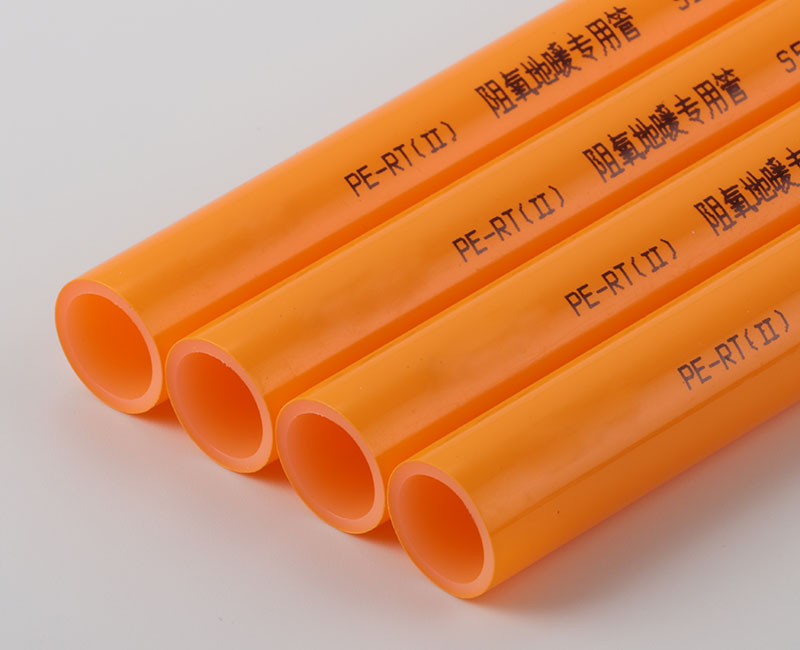
Underfloor heating can require large quantities of pipe installed permanently beneath finished surfaces.
Consistency therefore matters.
Manufacturing quality can influence:
- outside diameter;
- wall thickness;
- ovality;
- internal surface;
- barrier-layer uniformity;
- coil consistency;
- mechanical performance.
Bihe describes its manufacturing approach as using automated production lines, intelligent temperature control, online inspection, and full-process quality management for its core piping systems. Buyers evaluating larger projects can review the company’s manufacturing and quality capabilities alongside technical product specifications.
Installation Factors That Affect PE-RT Performance
Even correctly manufactured pipe can perform poorly if installation is incorrect.
During construction, installers should protect the pipe from sharp objects, severe kinking, excessive mechanical damage, and contamination.
Pipe circuits should be fixed securely enough to maintain the designed layout when the screed or floor layer is installed.
Pressure testing should normally be carried out according to the project specification before the pipe becomes permanently concealed.
The exact commissioning procedure depends on the heating-system design and applicable local requirements.
Proper documentation is especially valuable on commercial projects because it creates a record of loop layout and testing before the finished floor covers the pipe network.
Why System Design Matters More Than One Pipe Specification
A high-quality PE-RT pipe cannot compensate for a poorly designed heating system.
The performance experienced by the building occupant depends on the complete system:
heat source → controls → pump → manifold → pipe circuits → floor assembly → room heat loss
If circuit lengths are poorly balanced, one part of the building may receive more flow than another.
If insulation is inadequate, useful heat may be lost downward.
If pipe spacing is inappropriate, floor temperatures may become uneven.
If oxygen control is ignored in a system that requires it, metallic equipment may face additional corrosion risk.
The best PE-RT pipe selection is therefore one that fits a properly engineered heating system.
PE-RT Pipe Project Selection Checklist
Before approving a PE-RT pipe specification, confirm the following:
| Item | Confirmed? |
|---|---|
| Building/application type | □ |
| Heating-system design | □ |
| PE-RT material type | □ |
| Pipe diameter | □ |
| Wall thickness | □ |
| Operating temperature | □ |
| Working pressure | □ |
| Oxygen-barrier requirement | □ |
| Coil length | □ |
| Circuit design | □ |
| Fitting/manifold compatibility | □ |
| Applicable standard | □ |
| Testing requirements | □ |
| Packaging requirements | □ |
| Project quantity | □ |
Using a structured checklist reduces the chance of discovering specification conflicts after materials arrive on site.
Frequently Asked Questions
What is PE-RT pipe mainly used for?
PE-RT pipe is commonly used in underfloor heating, radiant heating, selected hot-water systems, and other applications that require flexible piping with elevated-temperature capability.
Is PE-RT good for underfloor heating?
Yes. Its flexibility and elevated-temperature performance make PE-RT well suited to hydronic floor-heating circuits when the correct pipe grade, dimensions, system design, and installation method are used.
Does PE-RT pipe need an oxygen barrier?
Not every application has identical requirements. Oxygen-barrier pipe is particularly relevant to closed-loop heating systems where oxygen diffusion could contribute to corrosion of metallic boilers, pumps, manifolds, valves, or other components.
What is the difference between PE-RT Type I and Type II?
Both are PE-RT materials recognized for elevated-temperature piping applications, but they have different material-performance characteristics. The correct type should be selected according to the pipe specification, operating conditions, applicable standard, and project requirements.
Can PE-RT pipe carry hot water?
PE-RT is designed for elevated-temperature applications and can be used in appropriate hot-water and heating systems. The exact operating limits depend on the product specification, pressure, temperature, application class, and applicable standard.
Is PE-RT the same as PEX?
No. Both are polyethylene-based piping materials used in heating applications, but PEX uses cross-linked polyethylene while PE-RT achieves elevated-temperature resistance through its polymer structure without the same cross-linking process.
How should PE-RT pipe diameter be selected?
Diameter should be based on heating load, required flow, circuit length, acceptable pressure loss, manifold design, and pump capacity rather than simply choosing the largest or smallest available size.
Why is flexible pipe useful for floor heating?
Flexible pipe allows installers to create long continuous circuits with fewer concealed joints, which can simplify installation and reduce connection points beneath finished floors.
Conclusion
Selecting the right PE-RT pipe requires more than checking diameter or maximum temperature.
A reliable underfloor heating system depends on the interaction between material type, pipe dimensions, operating temperature, pressure, oxygen-barrier performance, circuit length, pipe spacing, floor construction, fittings, and installation quality.
For B2B buyers, the most effective approach is to provide the pipe manufacturer with real project conditions rather than requesting a generic PE-RT product.
This allows technical parameters to be matched to the heating system before bulk production and installation begin.
Bihe provides PE-RT, PP-R, PVC, and PE piping solutions across residential and engineering applications. For floor-heating projects, project teams can review Bihe’s residential plumbing solutions and contact Bihe with pipe size, project quantity, temperature, pressure, drawings, or other technical requirements for a more targeted product recommendation.